
Most people treat ChatGPT like a basic intern for simple one‑off prompts. But you can unlock far higher output quality with five proven strategies. These methods come from real‑world experience as a CEO, board member and investor, observing how top teams leverage AI to gain a practical competitive edge.
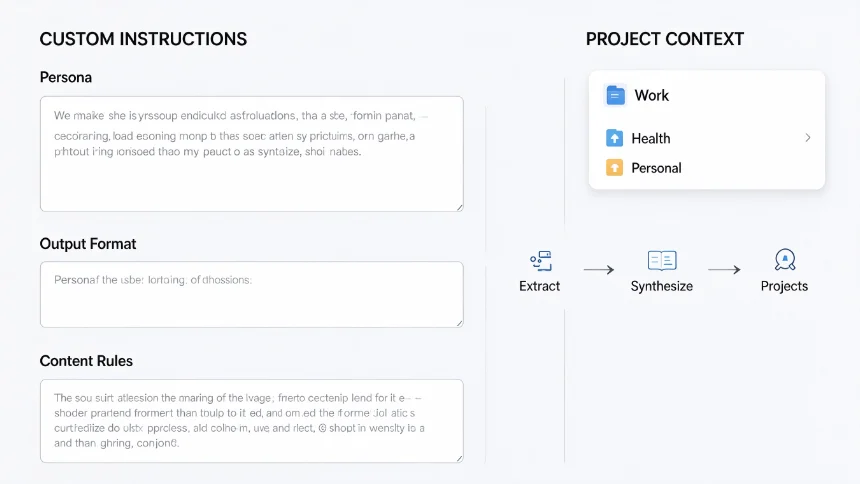
Strategy 1: Clone — Build persistent AI memory with the ESP framework
ChatGPT loses all context whenever you open a brand‑new chat window. The ESP framework fixes this, turning temporary conversations into your persistent digital brain.
- E‑Extract: Use ChatGPT voice mode for a long unscripted interview. Let it act as your chief‑of‑staff, interviewing you about your background, tone, priorities, blind spots. Do not edit yourself; capture raw thoughts.
- S‑Synthesize: Feed the interview transcript back to ChatGPT. Ask it to organize everything into a concise summary of your thinking style and preferences. Paste this summary into Custom Instructions. This sets default response format, tone and rules for every chat.
- P‑Projects: Use ChatGPT Projects as isolated context containers. Upload resumes, PDFs, datasets and set project‑specific instructions. Keep work, personal, health projects separated to avoid mixing unrelated context.
Strategy 2: Swarm — Deploy multiple AI capabilities in parallel
Instead of handling tasks one‑by‑one, assemble an AI swarm with three core roles:
- Your hands (Agent Mode):Dispatch bulk tasks. For example: find 50 SaaS leads, verify emails, rank by revenue. Let AI run heavy batch work in background. Limitation: cannot directly write data into external CRM systems.
- Your eyes (Multimodal vision):Upload photos of whiteboards, dashboards, defect screenshots. Ask AI to spot hidden problems and propose concrete fixes. It can catch details humans easily miss.
- Your research assistant:Offload heavy deep‑dive document analysis. Hundreds‑page dense reports can be processed in hours, work that once took human analysts weeks.
Key insight from the field: In the AI era, you bill for your judgment and taste, not raw working hours.
Strategy 3: Devil’s Advocate — Force adversarial thinking to beat your own bias
Humans suffer from the IKEA effect: we tend to be blind to flaws inside our own ideas, yet quickly spot mistakes in other people’s work. ChatGPT is hard‑wired to please users. You must break this “people‑pleaser” bias.
Three practical techniques:
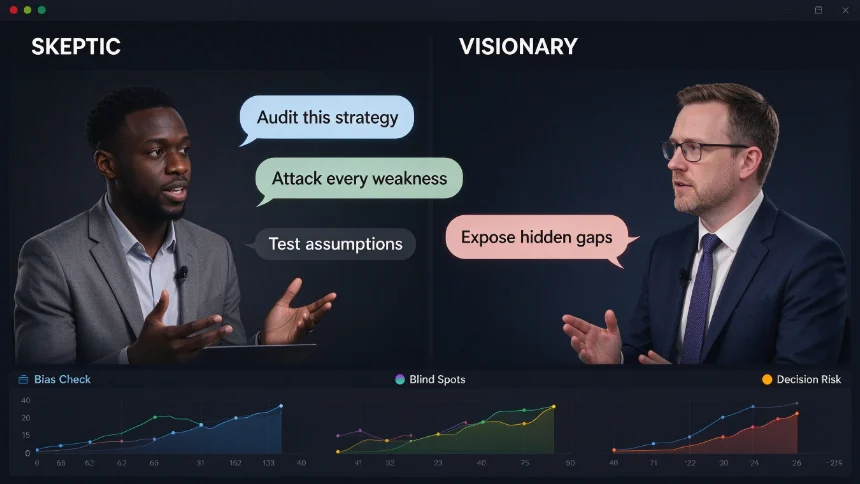
- Magic trigger prompts: Explicitly demand critical thinking. Example: “Audit this strategy using first principles” or “Act as my fiercest competitor and attack every weakness”.
- Shadowboxing simulation: Simulate real‑world debates. For instance, simulate a fight between skeptical venture capitalists and your product visionary. Expose weak points before real high‑stakes meetings.
- Blind‑spot check: Submit your strategy and ask: “Given everything you know about me, what are the gaps in my reasoning?” Protect yourself from ego‑driven bubble‑thinking.
Strategy 4: Neural Link — Gain true understanding, avoid empty fluent talk
Many users get only surface‑level eloquent answers without real comprehension, just like the famous Max‑Planck chauffeur anecdote. Use three techniques to build genuine mastery:
- Jargon translator: Re‑map complex concepts onto familiar metaphors. Example: explain API entirely using restaurant analogies. Translate foreign terminology into your own mental model.
- Progressive professor: Request layered explanations: explain concept for a 5‑year‑old, then for a 15‑year‑old, then for a college‑level audience. Follow this exact order to solidify understanding.
- Degree download: Let AI test you after learning new material. Instruct it to teach actionable skills and then quiz you, forcing you to explain knowledge back. This builds durable retention.
Strategy 5: Executive Coach — AI mirror for emotion & high‑stakes decisions
Great leaders need reflection space, especially for late‑night hard choices. ChatGPT voice mode can act as your temporary executive coach with three mirror exercises:
- Vomit mirror: Rant freely via voice mode. Tell ChatGPT to listen without interrupting. After you finish, have it organize chaos into three lists: solvable today items, delegatable items, noise to ignore.
- Stoic mirror: When facing failure or heavy setbacks. Ask AI to reframe your situation using stoic philosophy, uncover hidden opportunities, and slow emotional downward spirals.
- Decision mirror: Talk through big life choices (quitting job, founding startup). Lay out your logic and hold an open conversation. You do not need to trust AI’s conclusions; the value lies in clarifying your own thinking through articulation.
Quick overview of 5 strategies (Mobile‑friendly two‑column table)
表格
| Strategy | Core Purpose |
|---|---|
| Clone (ESP) | Build persistent personalized AI memory & context isolation |
| Swarm | Parallel multi‑role AI workforce for batch work, vision & research |
| Devil’s Advocate | Defeat cognitive bias, expose weaknesses in your plans |
| Neural Link | Truly master knowledge, avoid hollow surface‑level answers |
| Executive Coach | Process emotions, untangle thinking for high‑risk decisions |
Closing thoughts
These five strategies create an edge today. But over time, AI skills will become standard baseline capability. Your lasting competitive advantage will not come from prompt tricks alone. AI frees humans from repetitive labour. It invites us to lean into human strengths: emotion management, empathy, connection, subjective judgment — the parts machines cannot replicate.