The gap between people who can leverage AI well and those who cannot keeps widening. Most people misuse AI and get generic, shallow outputs. You can outperform 99% of users by following a structured 7‑step roadmap within 30 days, even as a total beginner.
Step1: Learn “Machine English” — Understand how AI actually works
Generative AI does not truly comprehend human language. It predicts next tokens based on probability. Text gets split into tokens, converted into multi‑dimensional vectors inside embedding space. Similar concepts sit close to each other mathematically. Vague prompts produce vague guesses. Sharp prompts deliver precise outputs.
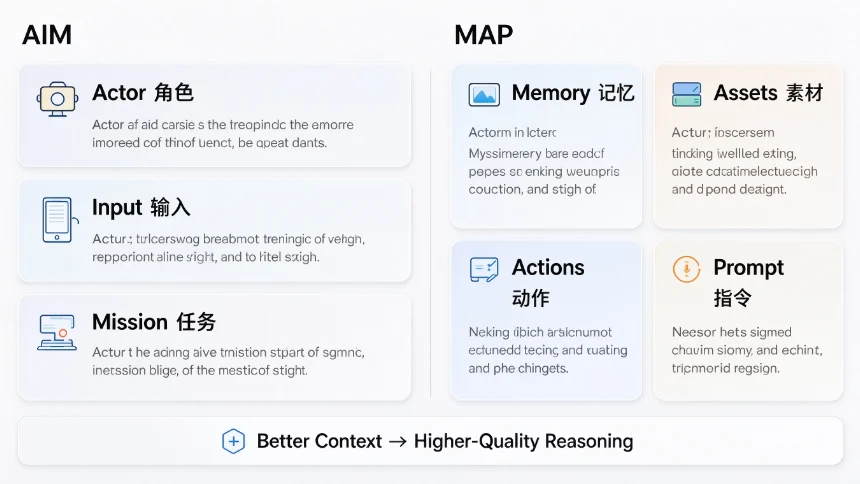
AIM prompt framework ‑ A‑Actor: Define who the AI should act as ‑ I‑Input: Supply context, data and reference materials ‑ M‑Mission: State your clear objective
Example: Instead of “fix my resume”, assign persona, attach resume & job description, give concrete improvement mission. Applying AIM can boost output quality significantly.
Step2: Pick one AI instrument and go deep
Common mistake: Trying dozens of AI tools superficially. Treat AI like learning a musical instrument. Master one tool deeply first, patterns transfer easily to others. ‑ ChatGPT: most mature general‑purpose tool ‑ Gemini: best for Google ecosystem users ‑ Claude: great for business & large project workflows
Spend week one exploring your chosen tool, learn its strengths, weaknesses and behavioral patterns. Practice writing AIM‑structured prompts until it becomes natural.
Step3: Build rich context with the MAP framework
Even powerful AI performs poorly without sufficient grounding context. Context is your navigation map inside embedding space.
MAP context framework ‑ M‑Memory: Conversation history, summaries of prior dialogues to maintain continuity ‑ A‑Assets: Attached files, documents, raw data ‑ A‑Actions: Tools the model can invoke: web search, drive access, document creation ‑ P‑Prompt: Your core instruction
Better memory + assets + actions = richer context and higher‑quality reasoning. Mastering AIM & MAP already puts you in top 10% of AI users.
Step4: Debug your thinking — Prompting is iteration, not one‑shot typing
Bad outputs are usually caused by flawed human prompting rather than AI failure. Iterate and debug. Three practical patterns:
- Chain‑of‑thought: “Think step by step. Show your reasoning then give concise final answer.”
- Verifier pattern: Ask AI to ask you clarifying questions one‑by‑one before answering.
- Refinement pattern: Request AI to propose two sharper re‑phrasings of your original question for you to pick.
Tweak, test and tune. Build mutual understanding between you and AI.
Step5: Steer toward expert‑level thinking
AI draws probability from massive training data; default outputs often are generic middle‑of‑the‑road opinions. Guide the model toward expert sources, established frameworks and research.
Bad vague prompt: “Explain how to build more innovative teams.” Improved prompt: “Explain team innovation drawing from Pixar Brain Trust, Satya Nadella’s strategy and Harvard research.”
If you don’t know relevant experts, first ask AI to list top researchers & papers, then feed those sources back into your prompt. Escape echo‑chamber generic responses.
Step6: Verify everything — Separate real insight from AI hallucination
AI can sound equally confident whether it is right or wrong. Five verification checks:
- Assumptions check: List all assumptions and rank confidence level
- Sources check: Require independent sources with title, URL and short quote
- Counter‑evidence: Ask for credible opposing viewpoints
- Audit numbers: Recompute figures, show math/logic
- Cross‑model verification: Run same prompt across ChatGPT / Gemini / Claude, let models critique each other’s outputs.
Step7: Develop your own taste with the OCEAN framework
Goal: Make AI output sound like you, not generic copy‑paste content. Treat AI as your intellectual sparring partner.
OCEAN framework ‑ O‑Original: Demand non‑obvious, unique perspectives ‑ C‑Concrete: Require real examples, names and valid numbers ‑ E‑Evident: Make reasoning & supporting evidence visible ‑ A‑Assertive: Force clear thesis and stance, address counter‑arguments ‑ N‑Narrative: Shape content into coherent story‑driven flow
7‑Step Roadmap Quick Reference (Mobile‑friendly two‑column table)
表格
| Step | Core Focus |
|---|---|
| 1 | Machine English + AIM prompt framework |
| 2 | Deeply master one core AI tool |
| 3 | Build context using MAP framework |
| 4 | Debug & iterate prompts, three debug patterns |
| 5 | Direct AI toward expert frameworks & sources |
| 6 | 5‑dimension verification against hallucinations |
| 7 | Shape unique personal output with OCEAN framework |
Closing thoughts
Within 30‑days following this roadmap, you will improve dramatically. You are not merely training AI; you are training your own judgment. AI will not replace human work, it restores human value.