फील्ड रिपोर्ट
The Goldcrest: A Tiny Masterpiece of the Avian World
The goldcrest holds the title of the smallest bird in Europe, a miniature treasure that weighs roughly as much as a small coin. Its most striking attribute is the brilliant yellow stripe decorating the crown of its head, a feature that makes it both a favorite for birdwatchers and a fascinating example of biological detail. The species' name is derived from this golden band, which is edged in black; while both sexes possess it, the color is notably more vibrant in males. This crest is not merely for show, as the bird can lift and fan these feathers during territorial standoffs or to attract a mate.
Victor Julian Carrington
लेखक
प्रकृति नोट
नीचे पूरी वन्यजीव कहानी या रिपोर्ट पढ़ें।
विषय
वन्यजीव

The goldcrest holds the title of the smallest bird in Europe, a miniature treasure that weighs roughly as much as a small coin. Its most striking attribute is the brilliant yellow stripe decorating the crown of its head, a feature that makes it both a favorite for birdwatchers and a fascinating example of biological detail. The species' name is derived from this golden band, which is edged in black; while both sexes possess it, the color is notably more vibrant in males. This crest is not merely for show, as the bird can lift and fan these feathers during territorial standoffs or to attract a mate.
Living Environment and Feeding Habits
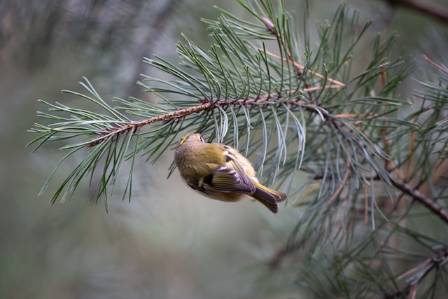
These birds are primarily found in coniferous forests, though they also frequent parks and residential gardens across Europe and various regions of Asia. They show a particular preference for fir and spruce trees, which provide ample opportunities to hunt for spiders and insects. Utilizing fine, needle-like beaks, goldcrests are expert at extracting small invertebrates from deep within tree bark and foliage. Their physical coordination is exceptional; they are known for their acrobatic ability to cling upside down to thin branches while searching for their next meal.
Migration and Resilience
In much of their territory, goldcrests are year-round residents. However, populations inhabiting the colder northern latitudes must journey south to survive the winter months. For a creature of such small stature, this migration is an incredibly perilous feat, involving vast distances and significant physical strain. Despite these challenges, their continued presence throughout Europe—even during the coldest seasons—serves as a powerful example of the resilience found in small packages.
Cultural Significance and Folklore
The goldcrest occupies a unique place in European history and mythology. During the Victorian era, it was frequently dubbed the "king of the birds." This regal title stems from an ancient legend in which the birds held a contest to see who could fly the highest. The clever goldcrest supposedly won by hiding in the feathers of an eagle; once the larger bird became exhausted and reached its peak altitude, the tiny goldcrest hopped off and flew even higher on its own.
Species Profile and Biological Data
Scientifically classified as Regulus regulus, the goldcrest is a diurnal insectivore that typically lives in social flocks. While they are not considered a threatened species and are categorized as "Least Concern" by the IUCN, they still face modern pressures such as habitat loss and climate change. Physically, they measure between 9 and 10 cm in length and have a wingspan of roughly 14 to 16 cm. They are prolific breeders, with females laying anywhere from 6 to 13 eggs per clutch, which are then incubated for approximately 16 to 19 days.

इसी जंगल से और

· hi
क्या है एक ग्रह?
विराट

· en
Brown Sugar and Soy Glazed Roast Duck
Vincent Fairbanks

· en
Celestial Wonders: The World’s Top 5 Stargazing Destinations
Isabella

· hi
दुनिया की सबसे अच्छी आइसक्रीम
कृष्ण

· en
How Well Do You Know Plant Shoots?
Lucas Mitchell

· hi
दक्षिण अफ्रीका के प्रसिद्ध पेंगुइन का दौरा: फॉक्सी बीच और बोल्डर्स बीच पर रुकें
पूजा