फील्ड रिपोर्ट
Zebras: Stripes, Survival, and Life in the Wild
Zebras are resilient, spirited creatures, full of contrasts that go far beyond their striking black-and-white patterns. They can be playful yet stubborn, social yet independent, tough yet vulnerable. Life in a herd can be complicated, but safety in numbers is part of their strategy. While they are prey for predators, zebras are also formidable defenders.
Kai Bennett
लेखक
प्रकृति नोट
नीचे पूरी वन्यजीव कहानी या रिपोर्ट पढ़ें।
विषय
वन्यजीव
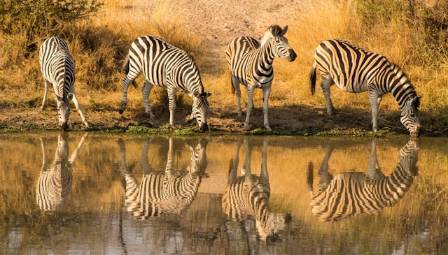
Zebras are resilient, spirited creatures, full of contrasts that go far beyond their striking black-and-white patterns. They can be playful yet stubborn, social yet independent, tough yet vulnerable. Life in a herd can be complicated, but safety in numbers is part of their strategy. While they are prey for predators, zebras are also formidable defenders.
Belonging to the equid family, zebras are close relatives of horses. They possess keen eyesight and sharp hearing, can sprint at speeds over 40 miles per hour (64 kilometers per hour), and deliver powerful kicks capable of injuring lions, hyenas, or African wild dogs. Typically, the stallion—the herd’s lead male—alerts the group to danger and positions himself at the rear to protect the herd, while mares and foals flee to safety.
Zebras move gracefully across vast distances by trotting, a pace that balances speed and endurance. Their tough hooves absorb impact and allow them to navigate rocky terrain with ease. At night, they often rest lying down, with at least one zebra standing guard to watch for ambushes.
Stripes: Black on White or White on Black?
One of the most debated questions about zebras is the color of their coat. Most researchers consider zebras to have white fur with black (or occasionally brown) stripes. On many zebras, stripes fade or stop at the belly and inner legs, leaving much of the body white. Some genetic variations produce mostly dark zebras with lighter stripes. Beneath the fur, all zebras have black skin.
Their stripes are not just for show—they provide camouflage. When zebras gather, their overlapping patterns make it difficult for predators like lions or leopards to single out an individual. Stripes are unique to each zebra, helping researchers identify them.
There are three main species of zebra: plains, mountain, and Grevy’s. Each has distinct stripe patterns, ranging from narrow to wide. Generally, all zebras share the same body shape: a large head, muscular neck, long legs, a dorsal stripe along the spine, a tufted tail, and a bristly mane. Unlike horses, zebras do not have a forelock.
Grevy’s zebras are the largest species, weighing between 770 and 990 pounds (350–450 kilograms) and standing up to 5 feet (1.5 meters) at the shoulder. They have thick necks, large rounded ears, and thin stripes that extend to their belly. Their hindquarters show vertical stripes above the legs.
Mountain zebras have vertical stripes on their necks and bodies that gradually widen and become fewer across their haunches. Their rumps display a distinctive grid pattern, and a dark belly stripe runs along their white underside. Mountain zebras also have a noticeable dewlap on the throat, similar to an Adam’s apple.
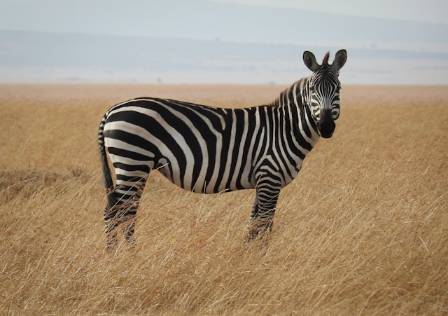
Plains zebras are the smallest and most numerous species. Some subspecies display “shadow stripes,” faint brownish stripes between their black ones.
Habitat and Diet
Zebra species occupy different habitats: Grevy’s zebras roam semi-arid grasslands in Kenya, Ethiopia, and Somalia; mountain zebras prefer rocky, dry slopes in Namibia and Angola; plains zebras inhabit savannas and woodlands across eastern and southern Africa. They are adaptable herbivores and among Africa’s most successful large mammals. Subspecies such as Grant’s zebras are famous for their mass migrations in the Serengeti, with herds of up to 10,000 individuals moving together during the rainy season.
Zebras are grazers, feeding primarily on grass, though they may also browse leaves and stems. They spend many hours daily cutting grass with their strong front teeth. During dry periods, zebras travel to find water and fresh pasture. Most species are nomadic, except Grevy’s zebras, where stallions defend territories that females and young move through freely. When resources become scarce, even these stallions may leave to join larger herds.
Family Life
Plains and mountain zebras live in family groups consisting of a stallion, several mares, and their offspring. At certain times of the year, multiple groups join temporarily, forming herds of hundreds, though family units remain intact. In contrast, Grevy’s zebras have no permanent social bonds. Males defend territories that females pass through to mate and give birth. Once foals are old enough, mares often leave the male’s territory to continue roaming.
Zebras communicate through facial expressions, sounds, and body language. They bray or bark loudly, or make soft snorts and whuffs. Ear position, eye openness, and mouth movements convey messages—flattened ears signal danger or submission. Grooming reinforces social bonds, as zebras nibble each other’s coats to remove loose hair and provide scratches.
Zebra foals are born with fuzzy coats, often brown and white striped. Their long legs allow them to walk within 20 minutes of birth and run within an hour, which is crucial for keeping pace with the herd. Foals imprint on their mother’s stripes to identify her and stay close, ensuring survival in the wild.
Conservation
Zebras face challenges such as habitat destruction, poaching, and disease. Mountain zebras are classified as Threatened, with populations historically decimated by hunting and competition with livestock. In 1937, South Africa established Mountain Zebra National Park when only 47 Cape mountain zebras remained; today, numbers have risen to several thousand, mostly within the park.
Grevy’s zebras are endangered, with fewer than 2,000 mature individuals in the wild. Organizations such as the San Diego Zoo Wildlife Alliance collaborate with the Grevy’s Zebra Trust in Kenya to protect and conserve these populations. By supporting conservation efforts, individuals help safeguard zebras and other wildlife around the globe.
इसी जंगल से और
· hi
आलूबुखारा और आलूबुखारा जूस के 10 बेहतरीन स्वास्थ्य लाभ
हर्ष
· hi
पारिस्थितिकी से परे: संस्कृति के केंद्र में पेड़
इश

· en
Best AI Robot Vacuums With Mops for Smart Cleaning
Victoria Clarke
· hi
रिंग-टेल्ड लेमूर
अक्षत

· en
Luxury Sedans That Inspired Modern Flagships
Parker Stone
· hi
तारों भरी रातें गायब हो रही हैं।
सिया