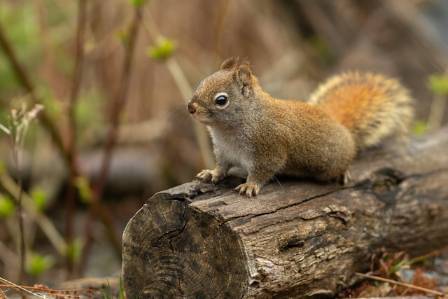
When thinking about common mammals in Illinois, squirrels are almost always top of the list. These furry creatures are a constant presence across seasons—scurrying up trees, darting across the ground, and busily burying nuts in fall. Unlike many animals, they don’t hibernate, remaining active on mild winter days, while spring and summer’s leafy canopies hide them but never keep them far. Though we often take them for granted (unless they’re raiding bird feeders), squirrels are far more interesting than their everyday appearance suggests. Dive into five fun facts that reveal the quirky, clever world of these squirrelly critters.
Chipmunks Are Part of the Squirrel Family
When we picture squirrels, tree squirrels—gray, fox, and red squirrels scampering up trunks—usually come to mind. But chipmunks, along with 13-lined ground squirrels, are also squirrels, classified as ground dwellers rather than tree dwellers. All belong to the Sciuridae family, which includes tree squirrels, ground squirrels, prairie dogs, and marmots like woodchucks. Globally, there are over 200 squirrel species, found everywhere except Australia, according to National Geographic. As rodents, all squirrels share key traits: their four front teeth grow continuously (requiring frequent gnawing to keep them in check) and they cannot vomit—two quirks that shape their behavior and survival.
Size Extremes: From Tiny Pygmies to Giant Tree-Dwellers
Locally, Illinois’ three tree squirrel species—eastern gray, fox, and red squirrels—are roughly similar in size, with fox squirrels the largest and red squirrels the smallest. But worldwide, squirrels span dramatic size ranges. On the giant end, Indian giant squirrels dwarf their U.S. cousins: they can reach 3 feet long and weigh 4 pounds (twice the size of fox squirrels) and sport striking multicolored fur in shades of brown, maroon, purple, and orange, as noted by Smithsonian Magazine. They’re one of four giant squirrel species native to Asia. At the opposite end is the African pygmy squirrel, a mere 5 inches long from head to tail (per National Geographic)—tiny enough to fit in your palm as an adult, compared to our 11–14 inch red squirrels.
Frequent Theft Victims (and Masters of Deceptive Caching)
Squirrels prepare for winter by caching food, mostly nuts, and they’re prolific hoarders—burying up to 3,000 nuts a year, according to Scientific American. This surplus is a good thing, because theft is rampant: the National Wildlife Federation reports that about 25% of their hidden food gets stolen by other squirrels. To combat this, squirrels practice “scatter hoarding”—hiding food in dozens of small caches instead of one spot—but even that isn’t foolproof. Their clever defense? Deceptive caching: digging a hole, covering it up, and walking away without depositing a nut. This fake burial is thought to confuse potential thieves, protecting their real food stores.
Zigzag: A Life-Saving Escape Strategy

Tree squirrels can run up to 20 mph, but many predators (birds of prey, coyotes, foxes) are just as fast—so speed alone isn’t enough to survive. Instead, they rely on a zigzag running pattern to evade capture, the National Wildlife Federation explains. Changing direction abruptly forces predators to adjust mid-chase, a challenge whether hunting on land or in the air. Unfortunately, this trick backfires with cars: zigzagging across roads keeps squirrels in harm’s way longer, increasing the risk of being hit. Despite this flaw, the strategy works well against natural predators. Squirrels play a vital ecological role: their nut-burying aids reforestation, and they’re a key food source for coyotes, foxes, hawks, owls, and other raptors, per Wildlife Illinois.
They Can Survive Falls From Any Height
Unlike cats (which famously land on their feet), squirrels don’t always stick the landing—but they can survive a fall from any height. The secret lies in their small size and unique falling technique, according to McGill University’s Office for Science and Society. Being lightweight means gravity exerts less force on them, but they enhance this advantage by instinctively spreading their bodies and extending their legs mid-fall. This increases wind resistance, slowing their descent and allowing them to glide gently to the ground—similar to how flying squirrels “fly” (they actually glide) using the same principle. Flying squirrels don’t have wings, but their outstretched legs and loose skin create a parachute effect, letting them glide through the air.
Conclusion: Our Fascinating Furry Neighbors

Squirrels may be common, but their adaptability, cleverness, and unique traits make them remarkable. From their diverse family tree (including chipmunks and giants) to their theft-defying tactics, zigzag escapes, and gravity-defying falls, these creatures have evolved countless ways to thrive. Next time you spot a squirrel darting across your path or burying a nut, take a moment to appreciate the complexity behind their seemingly simple behavior—they’re far more than just feeder raiders; they’re integral parts of our ecosystems and endlessly entertaining neighbors.