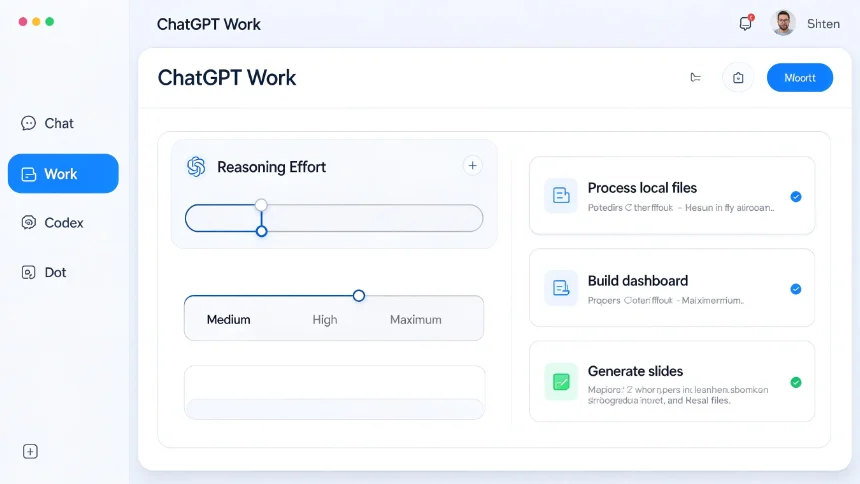
ChatGPT Work is purpose‑built for completing end‑to‑end deliverables, setting it apart from regular conversational ChatGPT. While standard chat works best for back‑and‑forth dialogue, Work handles multi‑step heavy‑duty jobs: processing local files, building dashboards, generating presentation decks, reading emails, capturing meeting notes and scheduling recurring tasks.
This walkthrough covers core capabilities and hands‑on business examples for ChatGPT Work, updated for GPT‑6.1 Astra. We will also clarify when you should pick Work versus ordinary chat mode.
The difference: ChatGPT Chat vs ChatGPT Work
Regular Chat chat mode optimises for quick interactive dialogue, short answers and real‑time exchanges.
ChatGPT Work is designed for multi‑step project‑oriented deliverables. It spends more reasoning cycles, can process batches of source files, and outputs finished artifacts like spreadsheets, presentations and web dashboards.
- Chat: Best for questions, brainstorming, quick feedback, ongoing conversation.
- Work: Best when you need completed, export‑ready output after complex multi‑step processing.
Note: ChatGPT Work has heavy restrictions on free tier. Full functionality requires Pro or Business plan; local folder access is only available inside desktop application. You can adjust reasoning effort slider from medium up to maximum for complex assignments.
Desktop‑only feature: Projects & local folder access
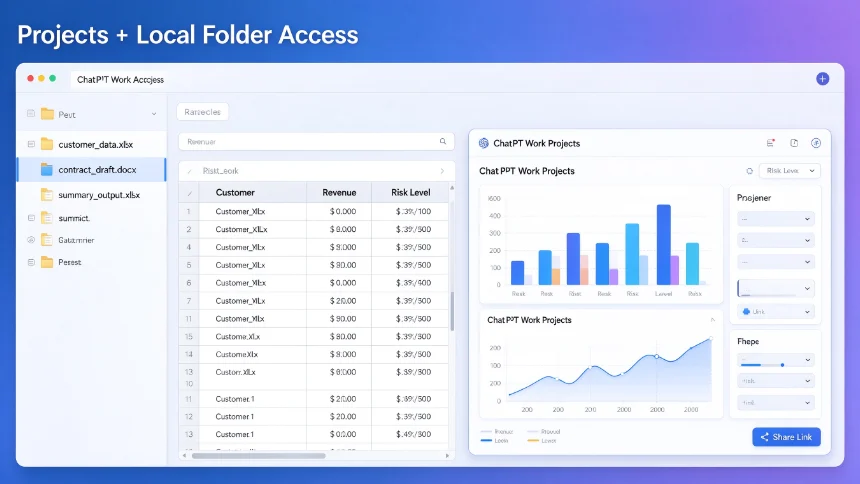
One of Work’s most powerful advantages exists exclusively on the desktop app: Projects, granting direct access to local folders on your computer.
Workflow:
- Create a new Project inside ChatGPT Work desktop client.
- Assign a local folder path to this project.
- Place spreadsheets, contracts, source documents inside that folder.
- ChatGPT Work can read, process and write files directly into this folder, no manual file‑upload required for every task.
This is extremely useful when you work with batches of messy business files, multiple spreadsheets or sets of contract drafts. You can still manually upload individual files via the files tab if you are working on web version.
Use case 1: Consolidate messy spreadsheets & build shareable dashboards
Common business scenario: you receive many disjointed spreadsheets with customer or operational data. Instead of manually merging them in Excel, let Work handle cleaning, consolidation and visualization.
Sample task: Feed 12 scattered messy spreadsheets. Merge datasets, add summary sheet, identify at‑risk customers, then build an interactive share‑ready dashboard.
Steps:
- Put all source spreadsheets into your project‑linked local folder.
- Submit instruction to Work: read all spreadsheets in project folder, merge datasets, create summary tab, flag customers at risk of churning.
- Work outputs consolidated cleaned Excel saved back into your local folder.
- Follow‑up prompt: convert this cleaned spreadsheet into interactive web dashboard with shareable public link for team access.
You can use Request edit function to point to specific parts of output file for targeted revisions, instead of describing changes in plain text.
Use case 2: Compare documents and highlight changes
Comparing two contract versions or revised business documents is a frequent office chore. ChatGPT Work opens local files directly from your project folder, runs deep comparison and outputs a dedicated change‑summary spreadsheet listing modified clauses and corresponding page locations.
Prompt idea:
Compare the 2026‑contract.docx and 2027‑contract.docx inside current project folder. Output a spreadsheet that lists every changed clause, original text, revised text and page number for each modification.
Use case3: Reuse template files to generate presentation slides
If you maintain fixed‑branded PowerPoint templates, Work can reuse your existing template design, inject new datasets and populate slides including speaker notes.
Workflow:
- Store your branded PowerPoint template together with updated data spreadsheet inside project folder.
- Instruct Work: build presentation based on this template, insert new business numbers from spreadsheet, generate corresponding speaker notes.
- It outputs finished PowerPoint preserving original font, color scheme, logos and layout.
Plugins extend Work capability
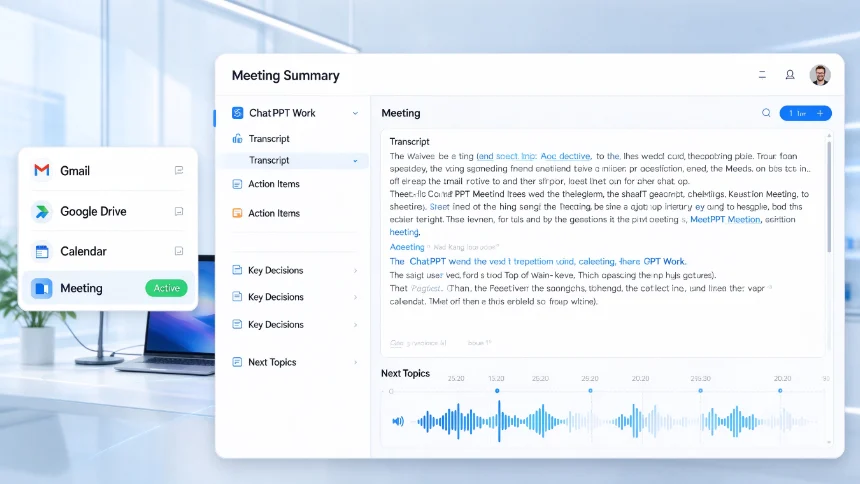
Plugins unlock connections to external services, greatly expanding what Work can accomplish. Popular integrations include Gmail, Google Drive, Calendar, and the brand‑new Meeting plugin.
Practical example — Gmail plugin
You can have Work read contact lists, draft email replies without automatically sending. Always add guardrails in prompt to avoid unintended outbound emails.
Sample prompt snippet:
Draft check‑in emails for contacts from the contact‑list spreadsheet in project folder. Save all messages as Gmail drafts. Do NOT send any emails, require my manual approval before dispatch.
New Meeting Plugin (Mac desktop, Business / Pro plan)
Available only for Mac desktop app. When enabled, ChatGPT runs in background while you hold Zoom or other calls. It captures meeting audio, produces full transcript, structured summary, action items, future discussion topics. The complete meeting record saves directly into your Spaces.
Template Creator: Turn finished documents into reusable templates
Template Creator is a high‑productivity feature inside ChatGPT Work. You can take existing finished files such as proposals, price quotations, turn them into saved reusable templates, paired with supporting reference files like pricing sheets.
How to use:
- In Work chat, call
@Template Creator. - Point to your existing proposal document plus supporting pricing sheet. Command it to build reusable template.
- Save and name the template.
- In new conversation, call your saved template, supply new business parameters, and Work generates a brand‑new ready‑to‑export proposal.
No need to repeatedly explain formatting rules and document structure every single time.
Sites: Generate shareable web pages & dashboards
Using @Sites inside Work, you can generate functional web pages, internal team dashboards. It produces public shareable links; custom domain setup is also supported. You can feed data from previously‑processed spreadsheets, build team‑facing dashboard, then share link with collaborators without exporting static files.
Spaces: Organise your work outputs
Spaces acts like an integrated Notion‑style workspace within ChatGPT. You can create folders and editable pages, import chat conversation history, attach generated spreadsheets, slides, charts.
You can create a new Space directly via prompt:
Create a new Space named [Name], convert this entire conversation into a summary‑formatted page inside the Space.
All meeting transcripts, generated documents, dashboards can be stored inside Spaces for later review and context reference.
Scheduled recurring tasks
ChatGPT Work supports scheduled recurring jobs. Instead of triggering manually, set tasks to run daily / weekly / custom intervals.
Common example: every Friday read your Gmail inbox and compile a concise weekly email summary. After you define task in Work conversation, it registers to scheduled‑task panel, where you can adjust frequency, pause or view execution history.
Mobile App support
ChatGPT mobile app now includes Work capability. You can assign multi‑step complex tasks by text input. It also supports updated voice input: speak your task requirement on‑the‑go, let Work process it remotely, then review completed deliverables later on desktop computer.
Closing thoughts
ChatGPT Work shifts AI usage from merely conversational Q&A toward real project‑completion work. It excels at multi‑step file processing, document generation, automation‑oriented tasks.
Remember: many advanced functions rely on desktop‑only features and paid subscription. Match your use case: quick questions stay in regular Chat; when you need finished exportable deliverables, switch to Work mode.