फील्ड रिपोर्ट
Handy Facts to Know about Hermit Crabs!
Hermit crabs are some of the most interesting animals found in marine environments. Famous for carrying empty shells on their backs, these unusual creatures play an important role in maintaining healthy ocean ecosystems.
Cassian Rhodes
लेखक
प्रकृति नोट
नीचे पूरी वन्यजीव कहानी या रिपोर्ट पढ़ें।
विषय
वन्यजीव
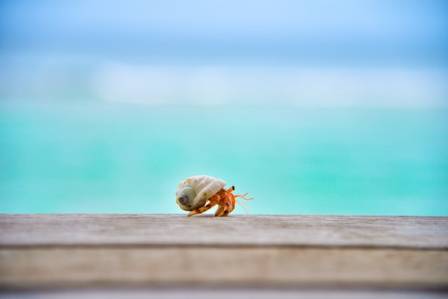
Hermit crabs are some of the most interesting animals found in marine environments. Famous for carrying empty shells on their backs, these unusual creatures play an important role in maintaining healthy ocean ecosystems.
Although their name suggests otherwise, hermit crabs are not true crabs. Their unique biology, behaviors, and relationship with their surroundings reveal the incredible variety found within marine life.
What Is a Hermit Crab?
Hermit crabs belong to the group known as Paguroidea and are classified as invertebrates, meaning they do not have a backbone.
Like true crabs, they have a protective outer shell called an exoskeleton. However, unlike traditional crabs, hermit crabs have soft, exposed abdomens and have adapted to use empty snail shells as additional protection.
Despite their crab-like appearance, hermit crabs are actually more closely related to lobsters than to true crabs.
How Many Types of Hermit Crabs Exist?
Scientists have identified more than 800 species of hermit crabs around the world. These species are generally divided into two main groups: land hermit crabs and aquatic hermit crabs.
Land hermit crabs spend most of their lives on land but must return to the ocean for reproduction. Aquatic species, including members of the genus Pagurus, remain underwater throughout their lives.
Each group has developed special adaptations that help them survive in their particular environments.
One interesting example is St Piran’s hermit crab (Clibanarius erythropus), a species recently found returning to waters around the United Kingdom after being absent for many years. This discovery demonstrates how marine ecosystems continue to change over time.
What Do Hermit Crabs Look Like?
Hermit crabs come in many different sizes, shapes, and colors depending on their species and habitat.
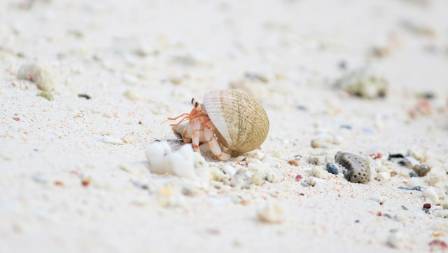
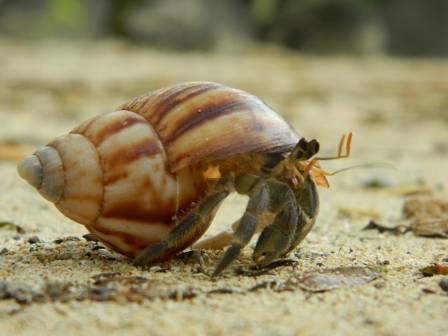
The front portion of their body is protected by a hard exoskeleton, while the rear part of their body remains soft and delicate. Because their abdomen lacks strong protection, they rely on empty shells from other mollusks for safety.
The shells they choose vary greatly in size, shape, and appearance, reflecting the wide range of environments where hermit crabs live.
Why Do Hermit Crabs Switch Shells?
Changing shells is an essential part of a hermit crab’s growth and survival. As the animal becomes larger, its current shell eventually becomes too small, forcing it to search for a more suitable home.
A larger shell provides protection from predators and shields the vulnerable abdomen from environmental dangers.
Hermit crabs sometimes compete with one another for better shells in a behavior known as shell fighting. When one crab leaves behind an old shell, another crab may quickly move in and reuse it, creating a natural recycling system within marine habitats.
What Do Hermit Crabs Eat?
Hermit crabs are omnivores, meaning they consume both plant and animal material.
Rather than actively hunting most of their food, they usually act as scavengers. Their diet can include algae, decaying plant matter, fallen leaves, dead fish, and other organic material.
This feeding behavior makes hermit crabs important members of their ecosystems because they help break down waste and return nutrients back into the environment.
Where Can Hermit Crabs Be Found?
Hermit crabs live in many different coastal environments, ranging from warm tropical coral reefs to cooler temperate shorelines.
They are commonly found in areas such as rock pools, sandy beaches, and seagrass habitats. When exploring tide pools or coastal areas, it is important to observe these animals carefully without disturbing their homes.
Removing shells, moving rocks, or interfering with their surroundings can damage the fragile ecosystems that hermit crabs and other marine creatures depend on.
How Long Do Hermit Crabs Live?
The lifespan of hermit crabs depends greatly on their species and living conditions.
In the wild, many species survive for around five years, although some individuals may live longer. With proper care in captivity, land hermit crabs can often reach 10 to 20 years of age.
Their longevity is influenced by factors such as diet, habitat quality, and access to appropriately sized shells. Without a suitable shell, a hermit crab becomes highly vulnerable to predators and environmental threats.
Do Hermit Crabs Interact with Other Animals?
Hermit crabs often form fascinating relationships with other marine organisms. One well-known example is their connection with sea anemones.
Certain parasitic sea anemones attach themselves to hermit crab shells, gaining advantages such as easier movement and access to leftover food particles.
In return, the anemones provide protection for the hermit crab. Their stinging tentacles can discourage predators from approaching, giving the crab an extra layer of defense.
The Important Role of Hermit Crabs in Nature
Although small and often overlooked, hermit crabs are valuable members of marine ecosystems. Their scavenging habits, shell recycling behavior, and relationships with other species help maintain balance in ocean environments.
These fascinating creatures demonstrate how even the smallest animals can have an important impact on the natural world.
इसी जंगल से और
· en
A Maritime Traveler Guide to River Cruising and Ten Crucial Insights Before Your Maiden Voyage
Ethan Caldwell
· en
How Well Do You Know Plant Shoots?
Lucas Mitchell

· en
Embrace Life's Simple Pleasures: A Path to Mindful Living
Finnian Storm

· hi
टेबल टेनिस के लाभ
मनोज

· hi
6 लोकप्रिय मातृ दिवस के फूल (और वे वास्तव में क्या मतलब है!)
सिया

· hi
टूटते तारों का विज्ञान
मीरा