फील्ड रिपोर्ट
Nine Surprising Truths About Camels
Camels are majestic land-dwelling mammals recognized primarily for the distinctive humps on their backs. These creatures are divided into three specific types: the dromedary, the Bactrian, and the wild Bactrian. The single-humped dromedary accounts for approximately 90% of all camels on Earth. In contrast, both the domesticated and wild versions of the Bactrian camel possess two humps. Currently, wild Bactrian camels are facing a severe crisis, with their total population dropping below 1,000 members.
Tristan Beckett
लेखक
प्रकृति नोट
नीचे पूरी वन्यजीव कहानी या रिपोर्ट पढ़ें।
विषय
वन्यजीव
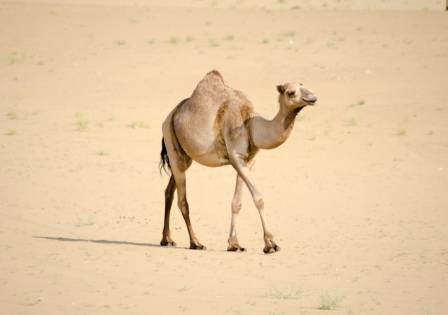
Camels are majestic land-dwelling mammals recognized primarily for the distinctive humps on their backs. These creatures are divided into three specific types: the dromedary, the Bactrian, and the wild Bactrian. The single-humped dromedary accounts for approximately 90% of all camels on Earth. In contrast, both the domesticated and wild versions of the Bactrian camel possess two humps. Currently, wild Bactrian camels are facing a severe crisis, with their total population dropping below 1,000 members.
While domesticated Bactrian camels primarily reside in Central Asia, dromedaries are found across the Middle East and parts of Australia. Wild Bactrian camels are restricted to remote pockets within Mongolia and China. From their incredible energy storage capabilities to their rapid hydration skills, these animals possess a suite of unique biological traits that allow them to thrive in unforgiving climates.
A Trio of Distinct Species
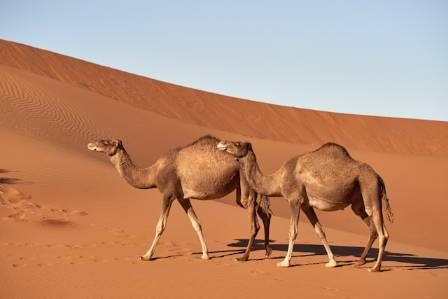
The global camel population is categorized into three species: the Arabian (dromedary), the Asian (Bactrian), and the wild Bactrian. Most camels seen today are tamed. The wild Bactrian remains the only species never domesticated, existing only in specific regions of Mongolia and China.
Dromedaries are characterized by their curved necks and a singular hump. Bactrian camels are easily identified by their double humps. Despite occasional cross-breeding between these types, there is no biological version of a three-humped camel. Both varieties are impressively tall; dromedaries typically reach six feet, while Bactrian camels can stand as high as seven feet.
The True Purpose of the Hump
A common myth suggests that camels use their humps to store water. In reality, these structures are reservoirs for fat. This concentrated fat serves as an internal pantry, releasing both hydration and energy when food and water are scarce. Additionally, by centralizing fat in a hump rather than distributing it across the body, the camel avoids excess insulation, which helps it remain cool under the blistering desert sun. A well-nourished camel can survive for several weeks without any external sustenance.
Masterful Desert Adaptations
The camel’s physical makeup is perfectly engineered for sandy, arid environments. They possess three eyelids and two rows of lashes to shield their eyes from debris. Their lips are exceptionally durable, allowing them to consume tough, thorny vegetation that other herbivores must avoid. Furthermore, they can seal their nostrils completely during sandstorms. To handle the heat of the ground, they feature thick, calloused skin on their knees and chests, and their broad, flat hooves prevent them from sinking into soft dunes.
Exceptional Hydration Capabilities
Although water isn't stored in their humps, camels are masters of fluid conservation. Dromedaries utilize a process called heterothermy, allowing their internal temperature to fluctuate throughout the day to minimize sweating. When they finally encounter a water source, they can rehydrate with astonishing speed, consuming up to 26 gallons of water in a mere ten-minute window.
Complex Social Structures
Camels are inherently communal animals that reside in herds. These groups can include up to 30 individuals and are typically led by a single dominant male. Outside of the competitive breeding season, they are generally peaceful. Group members communicate through various vocalizations, including bellows and moans. Young camels remain with their mothers for up to five years, often assisting with the care of newer offspring once they reach maturity.
A Source of Vital Nutrition
For millennia, human populations in desert regions have relied on camels for meat and milk. Camel milk is notably high in potassium, sodium, and Vitamin C, while containing less cholesterol than cow's milk. Many experts consider its nutritional profile to be closer to human milk than that of other ruminants. In areas where vegetation is sparse, camel meat serves as a critical source of protein for local communities.
Heavy Labor and Transportation
Camels are renowned for their strength and endurance. A Bactrian camel can transport up to 440 pounds, while a dromedary can carry roughly half that amount. They can travel over 60 miles in a single day while maintaining a steady pace. Their unique gait involves moving both legs on one side of the body simultaneously. Because they draw energy from the fat in their humps, they can work long hours in extreme heat without needing frequent stops for food.
Unique Sleep Patterns
Recent research indicates that camels sleep differently than many other large mammals. In a typical seven-hour night, they only enter a true sleep state for about 1.7 hours. The remainder of their resting period is spent in a state of semi-consciousness or "drowsing," which allows them to remain alert to potential threats. They are capable of resting while lying down or standing up.
The Fragile State of Wild Bactrian Camels
While domesticated varieties are plentiful, the wild Bactrian camel is on the brink of extinction. These animals are a genetically distinct species from their domestic cousins and live in only four isolated regions across China and Mongolia. Experts predict their population could decline by 80% in the coming decades. They face numerous threats, including illegal hunting, habitat loss, and competition for water and grazing land with domestic herds. In some areas, industrial expansion further endangers the remaining wild territory.
इसी जंगल से और

· en
4 Surprising Health Benefits of Eating Cake
Karter

· hi
प्रयोगशाला की पहली चिंगारी
डैनियल व्हिटमोर

· en
10 Exterior House Colors to Elevate Your Curb Appeal
Lincoln

· en
18 Fascinating Facts About the Canada Goose
Patrick Kennedy

· hi
दुनिया के सबसे प्रसिद्ध युद्धक विमानों में से 11
रफ़रसे

· hi
अमेरिका में 10 बेहतरीन जलवायु स्थलों
ईशानी