फील्ड रिपोर्ट
Essential Facts About the Mallard: North America’s Iconic Waterfowl
The Mallard is perhaps the most recognizable duck in North America, appearing commonly in lakes, rivers, and local ponds. As the most widespread duck on the continent, it has become the standard image people conjure when they think of waterfowl. While many populations are migratory—moving south from colder northern climates—others remain in the same region year-round if they have consistent access to food and open water.
Christopher Nolan
लेखक
प्रकृति नोट
नीचे पूरी वन्यजीव कहानी या रिपोर्ट पढ़ें।
विषय
वन्यजीव
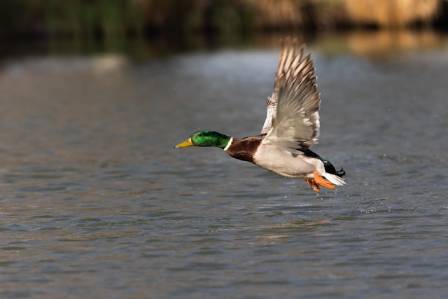
The Mallard is perhaps the most recognizable duck in North America, appearing commonly in lakes, rivers, and local ponds. As the most widespread duck on the continent, it has become the standard image people conjure when they think of waterfowl. While many populations are migratory—moving south from colder northern climates—others remain in the same region year-round if they have consistent access to food and open water.
Visual Distinctions Between the Sexes
Mallards exhibit significant sexual dimorphism, meaning males and females look remarkably different. The drakes, or males, are famous for their iridescent bottle-green heads, bright yellow bills, and a thin white collar around the neck. Their bodies are primarily a mix of brown and grey tones.
In contrast, the females, or hens, possess mottled brown and tan plumage that provides excellent camouflage while nesting. Their bills are typically orange with dark splotches. Despite these color differences, both sexes share a distinctive physical mark: the "speculum," a purplish-blue wing patch bordered by white lines that becomes visible during flight.
Vocalizations and Communication
A common misconception is that all ducks quack; however, among Mallards, this vocalization is exclusive to the females. The hen produces the classic series of "quacks," which usually start loudly and fade in volume. The males are much quieter, generally communicating through raspy, muffled calls or a rattling sound created by rubbing their bills against their feathers during courtship displays.
The Mechanics of Dabbling
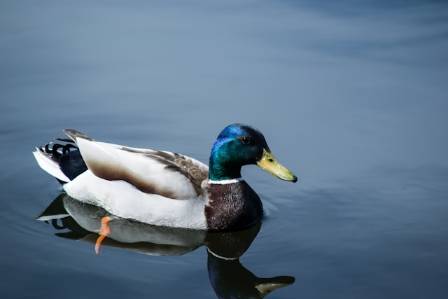
Waterfowl are categorized by how they hunt for food, and Mallards are "dabblers." Unlike diving ducks that submerge completely, Mallards feed by skimming the surface or tipping their bodies forward—tails up in the air—to reach underwater plants, seeds, and small invertebrates.
This feeding style is supported by their anatomy. Because their feet are positioned in the center of their bodies, Mallards walk quite gracefully on land compared to diving ducks, whose rear-set feet make them clumsy on solid ground but powerful swimmers underwater.
The Imprinting Process
Mallards are famous for "imprinting," a biological process where a hatchling identifies the first moving object it sees as its parent. While this is a vital survival mechanism for following their mother to water, it can be problematic if a duckling imprints on a human. Once a duck associates humans as its own kind, the process cannot be reversed. This often leads to "mal-imprinted" ducks that lack a natural fear of people, potentially becoming aggressive or territorial as they reach maturity.
Nutrition and Environmental Health
While it is a popular pastime, feeding bread to Mallards is harmful to their health. High-carbohydrate human foods like crackers and bread lack the essential nutrients found in a duck's natural diet of insects, snails, and aquatic vegetation. Consuming too much "junk food" can lead to "angel wing," a permanent deformity where the wing joints grow incorrectly, often leaving the bird unable to fly.
During the spring breeding season, Mallards naturally pivot their diet toward protein-rich animal life like larvae and crustaceans to support the energy demands of nesting. Throughout the rest of the year, they primarily consume aquatic plants and grain.
इसी जंगल से और
· hi
बेहतरीन रोटिसरी चिकन चुनने की रणनीतियाँ
मुकेश जोशी
· en
Eight Secrets of the Taj Mahal
Morgan Ellis
· hi
संयुक्त राज्य अमेरिका की 10 सबसे ऊंची इमारतें
बलराम
· en
Timeless Automotive Icons: Celebrating the Pinnacle of Car Design
William Reed
· en
Who Leads the Global Robot Industry?
Lee
· hi
इतिहास की 10 सबसे रंगीन पेंटिंग
आर्यन