फील्ड रिपोर्ट
Why Wild Woodpeckers Love To Hammer On Your House And How You Can Stop Them
Wild birds often peck at human homes for specific biological reasons. Many homeowners find this behavior highly frustrating. The loud tapping sound usually signals a desire to establish a local territory. Male birds drum rapidly on resonant surfaces. They do this to attract a breeding mate. This loud drumming does not relate to finding food. The noisy behavior typically stops once the spring mating season finishes. Another major reason involves building a comfortable home. The birds frequently want to excavate a deep nest. They also dig safe roosting holes. These nesting cavities feature a very smooth and perfectly rounded appearance. The birds usually construct these large holes between late April and early May. Homeowners who wish to evict these birds must act carefully. They should take action either before or after this specific nesting period. Searching for hidden food also drives this destructive behavior. The birds often peck at wood siding to find tasty insects hiding underneath. These foraging holes look very small. They are also highly irregular. Property owners might need to hire a pest control expert. A professional can solve the core bug issue. The birds typically target the larvae of carpenter bees. They also hunt leafcutter bees and grass bagworms. Some specific bird species hammer on walls to store their winter food. Certain western birds peck hundreds or even thousands of tiny holes. They drill these into large trees and utility poles. Sometimes they even target residential houses. They carefully hide a single fresh nut inside each individual opening.
Ellis Nathan
लेखक
प्रकृति नोट
नीचे पूरी वन्यजीव कहानी या रिपोर्ट पढ़ें।
विषय
वन्यजीव
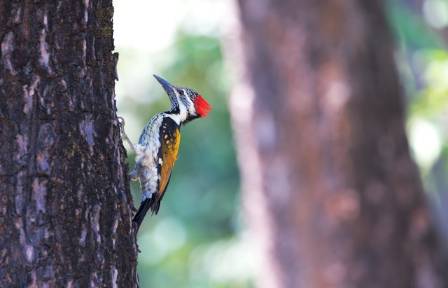
Wild birds often peck at human homes for specific biological reasons. Many homeowners find this behavior highly frustrating. The loud tapping sound usually signals a desire to establish a local territory. Male birds drum rapidly on resonant surfaces. They do this to attract a breeding mate. This loud drumming does not relate to finding food. The noisy behavior typically stops once the spring mating season finishes. Another major reason involves building a comfortable home. The birds frequently want to excavate a deep nest. They also dig safe roosting holes. These nesting cavities feature a very smooth and perfectly rounded appearance. The birds usually construct these large holes between late April and early May. Homeowners who wish to evict these birds must act carefully. They should take action either before or after this specific nesting period. Searching for hidden food also drives this destructive behavior. The birds often peck at wood siding to find tasty insects hiding underneath. These foraging holes look very small. They are also highly irregular. Property owners might need to hire a pest control expert. A professional can solve the core bug issue. The birds typically target the larvae of carpenter bees. They also hunt leafcutter bees and grass bagworms. Some specific bird species hammer on walls to store their winter food. Certain western birds peck hundreds or even thousands of tiny holes. They drill these into large trees and utility poles. Sometimes they even target residential houses. They carefully hide a single fresh nut inside each individual opening.
What Exactly Attracts Disturbers To Residential Homes
Scientific researchers conducted a major study involving more than one thousand residential homes. They discovered that roughly one third of these properties suffered from bird disturbances. Many sustained physical damage. The specific type of exterior siding plays a massive role. It actively attracts these animals. Grooved plywood siding suffers much more damage than other building materials. Furthermore the exterior color choice affects bird behavior significantly. Houses painted with earth tone stains face a much higher risk of damage. Properties painted in bright colors remain much safer.
Effective Methods To Protect Your Property And Keep Birds Away
Experts tested several common bird deterrents to see which methods work best over time. They evaluated plastic decoy owls with moving wings. They tested bright reflective streamers. They also analyzed plastic eyes hung on lines and specialized roost boxes. They even tried suet bird feeders and sound systems playing distress calls. The results showed that shiny reflective streamers work with the highest consistency. The metallic coating reflects light beautifully. The constant movement in the wind scares the birds. This method completely eliminated property damage at half of the testing locations. Decoy owls and electronic distress calls might work initially. However the birds quickly get used to these tricks. They eventually return to their old habits. Homeowners also report great success using simple items like windsocks. Colorful pinwheels also work well. Bright helium balloons made of shiny material work exceptionally well. Strips of ordinary aluminum foil and reflective tape can scare the birds away too. Some people prefer to cover the damaged areas with thick burlap sheets. Attaching heavy duty bird netting provides excellent protection. You can hang it from the overhanging roof eaves down to the siding. Property owners must ensure the netting stays completely tight. It should sit at least three inches away from the wall. This prevents birds from pecking through the mesh. The sides must remain tightly closed so birds do not get trapped underneath. Filling the existing holes with strong wood putty can discourage further hammering. Homeowners must check carefully before sealing the cavities permanently. Ensure no birds are hiding inside the holes. People should completely avoid using sticky chemical repellents on their walls. These tacky products can easily trap innocent animals. They often cause fatal injuries to wild birds.
इसी जंगल से और
· en
How to Draw Chibi Animals
Quinn Sterling

· en
Architectural Illustration Styles That Transcend Time
Jonathan Hayes

· hi
अटलांटा अब के लिए पांडा देखने के लिए हम में एकमात्र जगह है। लेकिन विदेशों में दर्जनों धब्बे उनके पास हैं
जूली वॉटसन

· en
Top 8 Fashion Brands Defining 2025 Style
Kennedy

· hi
चेरी के 7 प्रभावशाली स्वास्थ्य लाभ
रणवीर

· en
7 Pro Tips for Posing Confidently With Your Car
James