Small agencies don’t need a fancy enterprise automation platform to start. What they need is a short list of repeatable handoffs that break every client engagement: lead capture, qualification, proposal approval, client onboarding, project creation, content review, reporting, invoice reminders, meeting actions, and renewal alerts.
Automation is not about replacing account managers or specialists. It’s about making routine coordination happen consistently so the team can spend more time on client strategy and delivery.
Start with the handoffs that repeat across every client
The best first candidates are usually cross‑department handoffs. These are the moments when information moves from marketing to sales, from sales to delivery, from delivery to operations, or from operations to finance.
A lead form gets submitted but never assigned. A proposal gets approved but no one creates the project. A client signs the contract but the kickoff checklist never starts. Work finishes on time but the invoice gets delayed. These are not dramatic failures—they are the small, constant leaks that make an agency feel unorganized.
Small agencies should prioritize automating work that is digital, repeatable, rule‑based, and expensive when it falls through the cracks. Avoid automating highly creative strategy work or client consulting calls.
Ten high‑impact automation ideas for small agencies
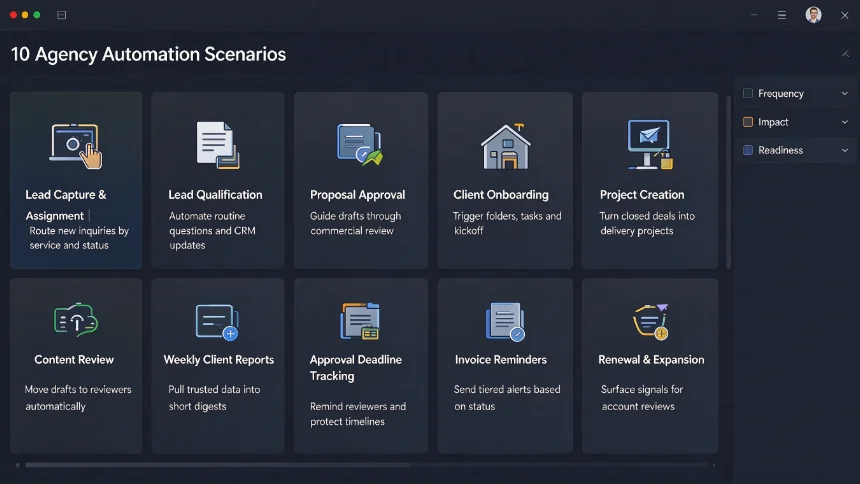
1. Lead capture and assignment
When a new lead arrives through the website, validate the required fields first. Then route it by service type, budget range, territory, or existing account status.
A simple rule might be: if the request includes “website redesign” and the budget field is above a defined threshold, assign it to the business development lead. If the lead already exists in the CRM, update the record instead of creating a duplicate.
2. Lead qualification and follow‑up
Some leads need human judgment, but many routine qualification questions can be handled automatically. After a lead is captured, trigger a sequence that asks for project timeline, team size, current tools, and budget expectations.
Use AI only to classify responses and summarize what the lead needs. The final assignment or disqualification should still happen inside the CRM by an account owner.
3. Proposal request and approval
When an opportunity moves into the proposal stage, create an internal task automatically. Pull the account context from the CRM and generate a draft proposal outline based on approved templates.
For high‑value proposals, route the draft to a partner or operations lead for commercial approval. Only after approval should the account manager send it to the client.
4. Client onboarding
Once a contract is signed, do not wait for someone to remember the next step. Trigger a standard onboarding workflow that creates the client folder, project plan, kickoff meeting, and initial tasks.
This is one of the most reliable automations an agency can build because onboarding usually follows the same pattern for every new client.
5. Project creation from sale
Many agencies lose momentum between sale and delivery. The moment a deal closes, create the project in the delivery tool, copy the approved scope, assign the account lead, and schedule the kickoff.
The key here is to keep the workflow simple. One record in the CRM should trigger one clean project setup path.
6. Content review and approval
If your agency produces content, use automation to move drafts through the review chain. When a piece is uploaded or marked ready, notify the copy reviewer, design reviewer, or client liaison.
Do not auto‑publish sensitive client work. Use the workflow to make sure every required review happens before publication.
7. Weekly reporting
Instead of rebuilding the same report every Friday, schedule a weekly digest that pulls performance data from key tools. AI can write the summary, but the metrics themselves must come from trusted sources.
Small agencies benefit most from reports that are short, consistent, and sent to the right people automatically.
8. Invoice reminders
Cash flow is a real problem for many small agencies. Use tiered invoice reminders based on due dates and customer history.
Send a friendly reminder before the due date, a stronger note after it is overdue, and an escalation message when the delay becomes significant. Suppress reminders if the payment is already received or in dispute.
9. Meeting follow‑up and task creation
After client meetings, the real work usually begins. Automatically capture meeting notes, extract decisions, identify action items, assign owners, and create deadlines.
This is where AI adds real value. It can turn messy meeting notes into structured tasks, but someone on the team should still confirm the output.
10. Renewal and retention alerts
Small agencies live or die by retention. Track when a client contract is approaching renewal, when usage has dropped, or when a key contact has not been active recently.
These alerts help the account team intervene early. Automation does not replace the retention conversation—it makes sure the conversation happens.
Build one reliable workflow before adding AI
Many small teams overcomplicate their first automation. They try to add AI steps, branching logic, and fancy dashboards before the basic path works.
A better approach is to build the smallest reliable version first. Define the trigger, the required data, the standard path, the exception path, the owner, and the success metric.
If the first workflow works, then add AI. Use AI for classification, extraction, summarization, and draft generation. Keep the deterministic parts—like updating records, sending reminders, or creating tasks—inside clear rule‑based logic.
How to prioritize when you have no operations team
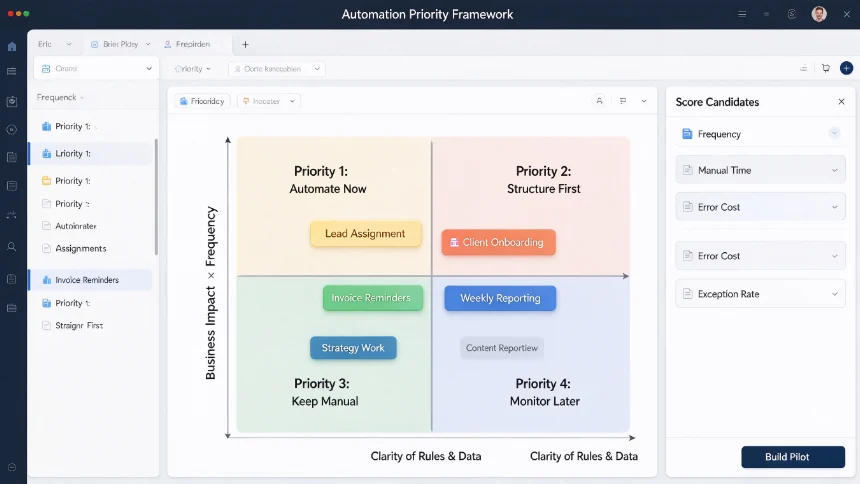
Small agencies usually do not have a dedicated operations manager. That is fine. Prioritize automation based on four practical questions:
- How often does this process happen?
- How much manual time does it consume?
- How much damage happens when it is missed?
- How clear are the rules and data?
If the answer is “very often,” “high manual time,” “real damage when missed,” and “reasonably clear rules,” it is a strong candidate.
If the process is one‑off, creative, politically sensitive, or based on unstable data, leave it manual for now.
The right tools for small agencies
Small agencies should start with tools that connect existing software without heavy engineering. Zapier and Make are good starting points because they work across many SaaS tools.
If the team already uses Microsoft 365 and Teams, Power Automate may be the better choice. If the team has at least one person who can maintain logic, n8n offers more control and self‑hosting flexibility.
Do not choose the platform with the most features. Choose the platform the team will actually maintain.
Keep governance simple
You do not need a complex governance framework. But every live workflow should have two things: a business owner and a technical maintainer.
The business owner makes sure the workflow still matches client needs. The technical maintainer fixes breaks, updates connections, and manages errors.
Other basics: separate test data from live data, log failures, send alerts to the right owner, and review the workflow every 30 to 90 days.
Final takeaway
The best automation ideas for small agencies are not the flashiest ones. They are the routines that happen every week across every client.
Start with lead assignment, client onboarding, project creation, invoice reminders, and meeting follow‑up. Build each one as a simple, reliable workflow first. Then layer in AI where it actually removes ambiguity.
Automation will not make a small agency bigger by itself. But it will help the team stop dropping the ball and start spending more time on the work clients actually pay for.