The buzz around multi-agent AI systems is loud. The reality is quieter: for most workflows, a single well-equipped agent outperforms a team of agents — until the work genuinely exceeds what one context can hold.
Here’s the practical guide to knowing which architecture fits your problem.
> **Sources:** Single vs multi-agent comparison from toolhalla.ai (2026-03-16), aiagentics.io (2026), dotcubetechnologies.com (2026-09-11), topsinfosolutions.com (2026-07-23).
What Each Architecture Actually Means
A single-agent system is one model running one reasoning loop with one prompt and one toolbox. It reads a goal, thinks, calls tools, observes results, and repeats until done. Everything stays in one context — no hand-offs, no coordination overhead.
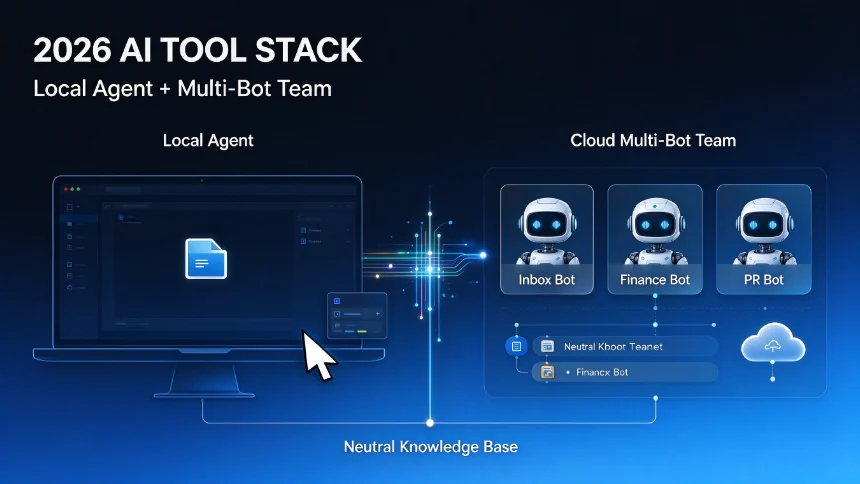
A multi-agent system distributes work across two or more agents, each with a narrower role and often its own tools. A lead or orchestrator decomposes the goal, assigns sub-tasks to worker agents, and stitches results back together. Coordination can be hierarchical (manager and workers) or peer-to-peer (agents negotiating directly).
The most common mistake: reaching for a multi-agent system when one capable agent would do. Complexity has to earn its place.
Head-to-Head Comparison
| Factor | Single Agent | Multi-Agent |
| System complexity | Low — one loop | High — coordination required |
| Token cost | 1x baseline | 10-15x baseline |
| Latency per step | Low | Higher (coordination overhead) |
| Total wall-clock time | Higher for parallel tasks | Lower (parallel execution) |
| Specialization | One general role | Deep — focused role per agent |
| Parallelism | No | Yes |
| Debuggability | Easy — single trace | Hard — trace spans agents |
| Best for | Focused, bounded tasks | Broad, decomposable workflows |
When to Use Which
Single-agent wins when: the workflow is sequential where each step depends on the previous one; you have one or two tool integrations rather than a dozen; the knowledge base is centralized; or you can describe the task as one worker doing one job from start to finish. It has fewer failure points by construction — no hand-off to drop a fact, no orchestrator to merge conflicting answers. When something goes wrong, you read one trace from top to bottom.
Multi-agent makes sense when: work genuinely spans multiple domains, tools, or teams and parts can run in parallel without waiting on each other. Specific signals: cross-functional workflows touching several departments; multiple business systems (ERP, CRM, inventory) feeding into one decision; parallel task execution where waiting would waste time; specialized domain expertise where one agent shouldn’t handle a completely different reasoning mode; and long-running workflows spanning hours or days.
Most production systems in 2026 use a hybrid: a single agent with selective sub-agent isolation for tasks that benefit from clean context — capturing 80% of multi-agent benefits at 20% of the complexity.
How to Decide: Five Questions
Before committing to either architecture, answer these:
1. How complex is the workflow? Three to five clear steps handled by one role means single agent. A workflow spanning multiple roles with different judgment calls is a signal for multi-agent.
2. Are tasks mostly sequential or parallel? Sequential work adds coordination overhead with no speed benefit. Genuinely parallel work is where multi-agent earns its cost.
3. How many systems need integration? One or two systems can be handled by a single agent with the right tool access. Four or more different systems tend to benefit from dedicated agents per integration.
4. Do tasks require genuinely different reasoning styles? A compliance check needs to be exhaustive and conservative. A customer-facing response needs to be fast and warm. If you need fundamentally different reasoning modes, specialized agents outperform one generalist.
5. Will the solution need to scale over time? If volume justifies distributed processing and the workflow can decompose cleanly, multi-agent scales better. If scope is bounded, simplicity wins.
Bottom Line
Default to a single agent. Add more agents only when the work decomposes into clean roles or exceeds what one context can reliably hold. The goal is not to maximize agents — it’s to build the simplest, most reliable system that completes the required task.
The most common architecture mistake is reaching for a team of agents when one would do — and the second most common is jamming a sprawling job into a single overloaded loop. Knowing which side of that line you’re on is most of the decision.