Generative AI now produces text, images, and video at scale. In 2026, an estimated 97% of content marketers use AI assistance for content generation, according to industry surveys. That creates a practical problem: when you encounter text online, how do you verify whether a human or an AI wrote it?
This guide covers what AI detection tools actually measure, how to run a practical verification workflow, and where the limits of detection lie.
What AI Detection Tools Actually Measure
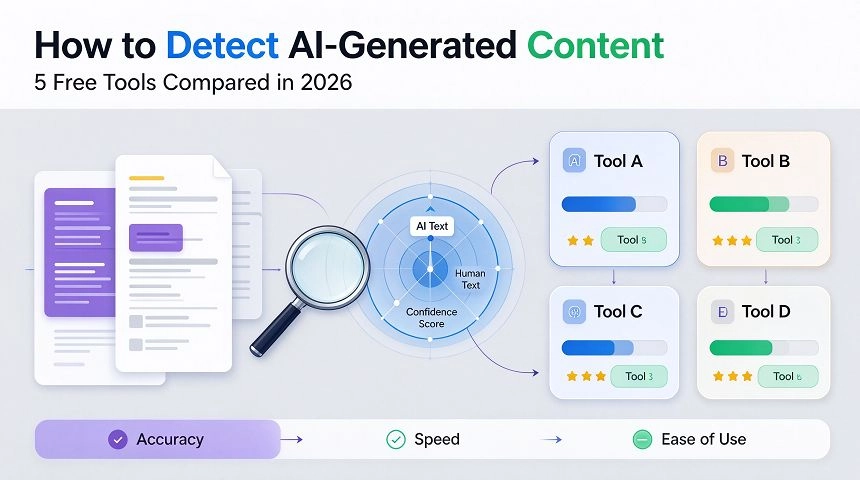
AI text detectors do not read content for meaning. They analyze writing patterns for statistical signals that distinguish AI-authored text from human writing. Three patterns are most commonly flagged:
Perplexity — how unpredictable each word is given the surrounding context. AI text tends to have low perplexity: each word follows the previous one with high predictability. Human writing tends toward higher unpredictability.
Burstiness — variation in sentence length and structure. Human writing naturally alternates between short punchy sentences and longer complex ones. AI text often maintains more uniform sentence length and rhythm.
Word choice patterns — certain function words (articles, prepositions, conjunctions) appear at different frequencies in AI text versus human text. AI detectors train on these statistical fingerprints to produce a probability score.
Detection tools vary in how they combine these signals. Some output a simple percentage (“87% likely AI-written”). Others label specific sentences or flag sections with unusual uniformity. Most paid tools also check for AI paraphrasing — text that was AI-generated then run through a humanizer tool.
No detector reads for meaning or intent. None verify facts. They are statistical pattern analyzers, not judgment engines.
The Practical Verification Workflow
For most content verification needs, this four-step process is sufficient:
Step 1: Run a quick scan with a free tool
Start with the free tier of a reputable detector. GPTZero and ZeroGPT both offer free web interfaces with no account required. Paste 300–500 words of the target text and run the scan. This takes under a minute and gives a first signal.
Tools like Scribbr offer unlimited free checks with a free account. Copyleaks provides a free tier. Winston AI offers a free tier with limited scans per month.
Step 2: Run a second check with a different tool
No single detector is definitive. Cross-reference with at least one other tool. If GPTZero says “87% AI” and ZeroGPT says “15% AI,” investigate further before drawing conclusions. Consistent results across multiple tools increase confidence.
In third-party accuracy testing, ZeroGPT and Pangram each achieved 6 out of 6 correct identifications (distinguishing AI text from human text) in small-sample tests. GPTZero also scored 6/6. Copyleaks and Copyscape’s AI detector scored 6/6. These are small samples — not statistically conclusive — but give a relative ranking among available free tools.
Step 3: Look for humanizing or paraphrasing signals
If a tool flags content as AI but you suspect it was subsequently paraphrased, use a tool with paraphrasing detection. Sapling, Originality.AI, and Winston AI include paraphrasing detection features in their paid tiers. Free tools vary in their ability to detect humanized AI text.
This step is necessary when evaluating content that may have been processed through an AI humanizer tool before publication.
Step 4: Read the content for human signals
Automated detection is a first screen, not a verdict. Read the text itself. Genuinely human writing tends to show: specific anecdotes, personality, non-standard sentence structures, emotional range, and firsthand observations. AI text at this point tends toward generic phrasing, formulaic transitions (“Furthermore,” “In conclusion,” “It is worth noting that”), and content that is factually correct but contextually flat.
Reading Detection Results Correctly
Most tools output a score between 0% and 100%. Interpret these ranges carefully:
0–30% AI probability: Usually human-written or heavily edited human text. Treat as likely human, but not definitive.
30–60% AI probability: Mixed or inconclusive. The text may be AI-assisted (human writing with significant AI editing), paraphrased AI text, or a human writer whose style happens to overlap with AI patterns. Do not treat as confirmed AI or confirmed human.
60–90% AI probability: Likely AI-generated or AI-assisted. Requires judgment call based on context.
90–100% AI probability: Strong signal of AI generation. Still not definitive — some specialized human writing can score in this range due to its uniformity.
The practical implication: detection tools are most reliable at the extremes (very low or very high scores) and least reliable in the middle zone. Do not use a single score in the 30–70% range as the basis for a factual claim that content is AI-generated.
Where Detection Tools Fall Short
Three specific conditions regularly produce incorrect results:
Humanized AI text: AI-generated content run through QuillBot, Paraphraser.io, or similar tools often scores as human on most free detectors. Paid tools with paraphrasing detection are more reliable here, but not perfect.
Short text under 300 words: Most detectors need sufficient text volume to establish statistical patterns. A single paragraph or a tweet-length post cannot be reliably analyzed. Some tools explicitly state minimum length requirements.
Non-native English writing: Human writers whose second language is English often produce text with statistical patterns that overlap with AI-generated text. Non-standard grammar and phrasing — from a human struggling with idiom and collocation — can be mislabeled as AI. Detection tools generally perform worse on non-native English than on native English writing.
No current detector is reliable enough to be used as the sole evidence in formal proceedings, academic integrity cases, or hiring decisions without additional human review.
Beyond Text: AI Image and Video Detection
AI-generated images are generally easier to verify than text. Look for: unnatural hand or finger rendering (extra fingers, fused fingers, unusual hand positions), asymmetric faces or ears, text rendering errors within images, and lighting inconsistencies between foreground and background.
For video, detection is harder in motion. Still frames from AI-generated video often show the same artifacts as AI images. Some services (Truepic, Getty Video) offer content authentication for video, but these require provenance tracking at the point of capture — they cannot retroactively verify anonymous uploads.
AI audio detection is less mature than text or image detection. Tools like ElevenLabs and Resemble.ai have internal provenance tracking, but no widely available free tool reliably detects AI-cloned voice in arbitrary audio recordings.
Building a Verification Practice
If you regularly need to verify content provenance:
Use a consistent workflow: run at least two different tools, check both raw text and humanized text, and always read the content itself before making a judgment.
Keep records of verification dates. AI detector accuracy changes as both the tools and the AI models they detect evolve. A tool that was accurate in 2024 may have different accuracy in 2026 against newer models.
Understand that no tool is a lie detector. AI detection tools measure statistical patterns, not truth. A factually accurate AI-generated article and a factually inaccurate human-written article will both score on their statistical properties — not on accuracy.
Frequently Asked Questions
Q: Can detection tools reliably identify content written by the latest AI models?
Detection tools are typically trained on patterns from specific AI models. Newer models that were not in the training data may produce text that scores lower on AI probability. No detector currently on the market is reliable against all known AI models.
Q: Is there a free tool that works as well as paid ones?
Free tiers of GPTZero and ZeroGPT perform well in small-sample accuracy tests (6/6 in one comparative test). Paid tiers typically add paraphrasing detection, batch processing, API access, and more frequent model updates. For occasional personal use, a free tier is often sufficient. For professional content verification workflows, paid tiers offer meaningfully better coverage.
Q: Can I use detection results to prove content is AI-generated in a legal or professional setting?
No current AI detection tool produces results that meet evidentiary standards. A detection score can support an investigation, but should not be the sole basis for formal accusations, hiring decisions, or legal proceedings without additional human review and corroborating evidence.