AI-generated text is everywhere. Blog posts, product reviews, academic essays — and it’s getting harder to tell what a human wrote and what a machine produced. Whether you’re an editor, a teacher, a content manager, or just someone trying to verify a source, you need reliable ways to check.
This guide compares five of the most widely used AI detection tools, focusing on free options and what each one actually delivers in practice. No hype, no “game-changing” claims — just a practical breakdown of how these tools work, where they succeed, and where they fall short.
What AI Detection Tools Actually Do
AI detection tools analyze text patterns and assign a probability score that the content was generated by an AI. They look at things like sentence structure variety, vocabulary predictability, and statistical anomalies. Most return a percentage score or a simple “AI / Human / Unclear” label.
Important caveat: No detection tool is 100% accurate. AI-generated text that has been lightly edited, combined with human-written sections, or produced by the latest frontier models can often pass undetected. Treat these tools as one signal among several, not as definitive verdicts.
Five Tools Compared
GPTZero
GPTZero was one of the first tools built specifically for AI text detection, created by a Princeton student. It offers a free tier that lets you check up to 5,000 characters per month without creating an account.
What it does well:
- Detects ChatGPT and GPT-4 generated text with reasonable accuracy
- Highlights specific sentences that most likely came from an AI
- Free tier is genuinely usable without payment
Where it struggles:
- Accuracy drops significantly with short texts (under 300 words)
- Heavily edited AI text often scores as human-written
- Limited batch processing on the free plan
Pricing: Free tier (5,000 chars/month); paid plans start at $10/month for higher limits.
Copyleaks AI Detector
Copyleaks is primarily known as a plagiarism checker, but its AI detection feature has become a standalone product. It claims to detect AI-generated content across multiple models including GPT-4, Bard, and Claude.
What it does well:
- Covers a wide range of AI models in one scan
- Offers browser extensions and LMS integrations
- Provides percentage scores with visual breakdowns
Where it struggles:
- The free version has strict usage limits
- Occasionally flags human-written academic text as AI-generated (false positives)
- Interface is more complex than simpler alternatives
Pricing: Free tier available; enterprise pricing on request.
Turnitin AI Detection
Turnitin is the plagiarism detection giant used by universities worldwide. In 2023, it added AI detection capabilities to its existing platform. This is one of the most widely deployed tools in academic settings.
What it does well:
- Already integrated into many university grading systems
- Provides detailed reports with highlighted sections
- High volume: can process entire class submissions at once
Where it struggles:
- Primarily available through institutional subscriptions — no direct consumer sign-up
- Not transparent about exact detection thresholds or model versions
- Some educators have raised concerns about false positives, particularly for non-native English writers
Pricing: Available through institutional licenses only; no public individual pricing.
Originality.ai
Originality.ai was built specifically for content marketers, publishers, and anyone who needs to verify that freelance or contracted content is original. It focuses on detecting both AI-generated text and plagiarism in a single scan.
What it does well:
- Designed for real-world content workflows
- Team and client sharing features
- Claims high accuracy on GPT-4 and Claude outputs
Where it struggles:
- No free tier — requires paid subscription from day one
- Best results require full articles (not snippets)
- Some community reports of false positives on well-edited AI content
Pricing: Pay-as-you-go from $0.01 per credit; monthly plans start at $10.95/month.
Winston AI
Winston AI is a newer entrant focused on educators and content teams. It offers OCR capabilities to scan printed documents and handwritten notes in addition to digital text.
What it does well:
- Can scan images and documents, not just digital text
- Provides visual heat maps showing AI-probable sections
- Offers a free trial without requiring credit card information
Where it struggles:
- Newer tool with a smaller testing base than established competitors
- OCR accuracy varies with document quality
- Free tier is limited in scan volume
Pricing: Free trial available; paid plans from $12/month.
How to Use These Tools Effectively
AI detection tools work best as part of a broader verification process. Here are a few practical guidelines:
Check the full context, not just the score. A low AI score doesn’t automatically mean human-written content, and a high score doesn’t prove the text was AI-generated. Look at which specific sentences triggered the flag and whether that makes sense.
Combine tools for harder cases. Running the same text through two or three different detectors gives you a more reliable signal. If all three flag the same passage, it’s more likely to be AI-generated.
Consider the author’s background. Non-native English writers may score higher for AI content due to phrasing patterns, even when the work is entirely original. Detection tools should never replace human judgment about intent.
Keep records of your checks. If you’re using these tools in a professional context (editing, grading, content management), note which tool you used, when, and what score it returned. This creates an audit trail if decisions are questioned later.
Which Tool Should You Use?
There is no single best AI detection tool. The right choice depends on your specific situation:
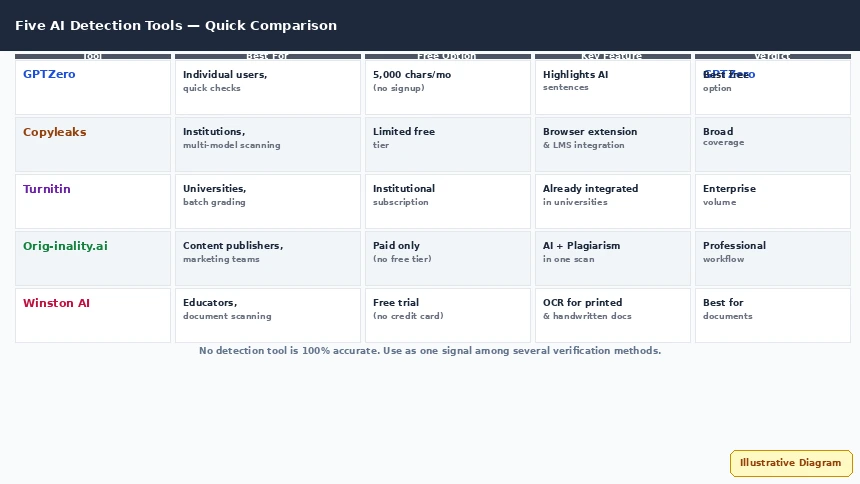
| Tool | Best For | Free? |
|---|---|---|
| GPTZero | Quick informal checks, students | Free tier |
| Copyleaks | Broad model coverage, institutional users | Limited free tier |
| Turnitin | University settings, high-volume grading | Institutional only |
| Originality.ai | Content publishers, marketing teams | Paid only |
| Winston AI | Educators, document/image scanning | Trial available |
For most individual users, GPTZero’s free tier is a reasonable starting point. For content teams or educators handling high volumes, the choice depends on your existing workflow and whether you need integrations with existing platforms.
Key Takeaways
AI detection tools have improved since 2023, but none are reliable enough to be the sole basis for important decisions. They work best when:
- Used to supplement human judgment, not replace it
- Combined with context about the author and situation
- Applied consistently over time to notice patterns
No detection score should override direct conversation with the person who wrote the content.