Most explanations for AI agents are either overly technical or oversimplified. If you use AI tools regularly but lack engineering background, you can grasp the core difference between LLMs, AI workflows and real AI agents through this three‑level framework. Popular jargon like RAG and ReAct becomes easy to understand once you sort these layers out.
Level 1: Basic Large Language Model — Simple Input‑Output
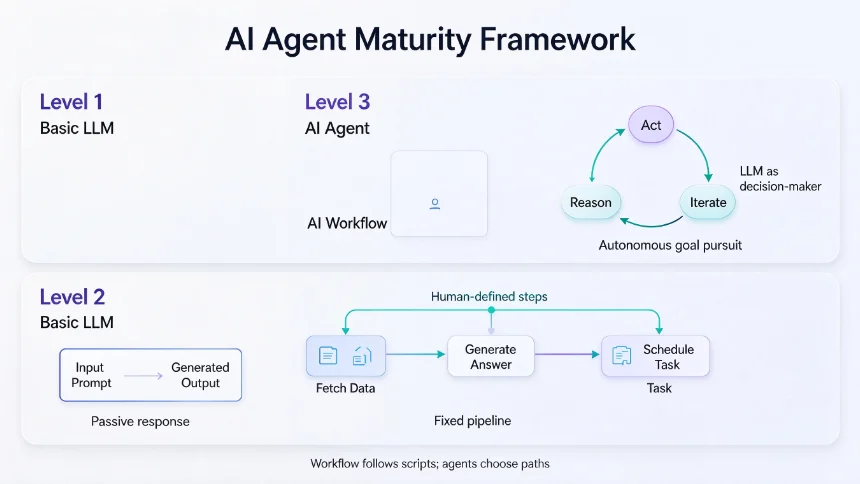
ChatGPT, Gemini and Claude are applications built on large language models. You send an input prompt, and the LLM returns generated output. LLMs own two inherent limitations:
- They have no native access to your private data, calendars, internal company files. They only rely on training data.
- LLMs are passive. They wait for human prompts and will not initiate any action by themselves.
Example: You ask the model to draft a coffee‑chat email and it works perfectly. But it cannot answer “when is my next coffee chat?” because it cannot read your calendar data without extra setup.
Level 2: AI Workflow — Human defines fixed paths
An AI workflow connects LLMs with external tools following pre‑defined human‑written logic. Every step sequence is set in advance by humans. The model strictly follows this fixed control logic.
RAG (Retrieval‑Augmented Generation) is essentially one type of AI workflow. It lets the model fetch external resources before generating answers.
Real‑world demo case built on make.com:
- Pull news article links into Google Sheets
- Use Perplexity to summarize articles
- Pass summaries to Claude for LinkedIn & Instagram post drafting
- Set automatic daily 8 AM execution schedule
All step sequences are predetermined by humans. Even if you add dozens of steps, it remains a workflow. When outputs are unsatisfying, humans must manually rewrite prompts and iterate. The human stays as the core decision‑maker.
Key distinction: In AI workflows, humans set every step order. The LLM only executes inside this fixed pipeline.
Level3: Real AI Agent — LLM becomes the decision‑maker
The critical shift from workflow to agent: replace human decision‑maker with the LLM. A true AI agent receives only a high‑level goal, not rigid step‑by‑step instructions. It completes tasks through three core capabilities:
- Reason: Figure out what approach and tools are most efficient for the target goal by itself.
- Act: Call external tools to execute operations.
- Iterate autonomously: Critique and refine its own outputs without human manual prompt edits.
The well‑known ReAct framework exactly matches this logic: Reason + Act. The agent loops through reasoning‑action‑observation cycles until the task goal is fulfilled.
In our social‑media‑post example: Instead of humans arranging each step, the AI agent independently decides whether to collect links inside Google Sheets, which summarization tool to use, and even critiques its own drafted LinkedIn posts. It repeats revision cycles until output meets quality standards.
Another practical vision‑agent demo: given the keyword “skier”, the agent reasons what skier features look like, scans video footage, indexes matching clips and returns results. All planning and judgement happens inside the AI instead of human pre‑programmed tags.
It is critical to tell AI workflows and AI agents apart. Workflows follow rigid human‑defined scripts step‑by‑step. True agents receive only a high‑level goal and work out their own paths to get things done. Understanding these three layers helps you cut through marketing buzzwords and evaluate real‑world AI tools more objectively.